Last updated on
CronDeck - Cron Jobs & Uptime Monitoring
📌 Overview
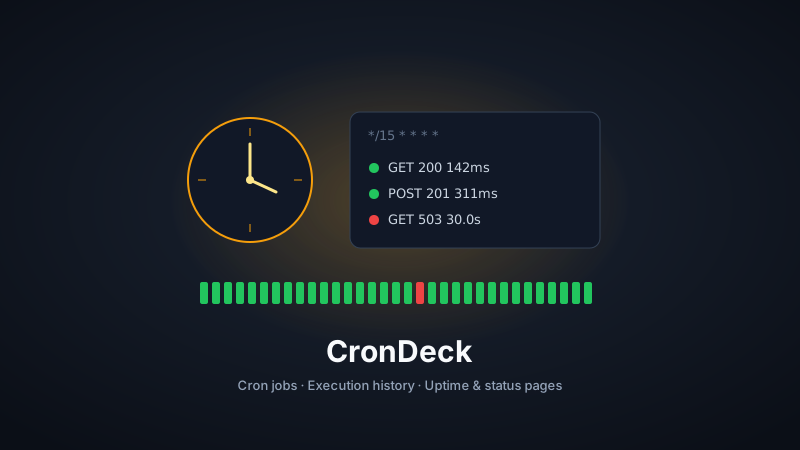
CronDeck is a cron-as-a-service platform for developers. You schedule HTTP requests with cron expressions, and every execution is recorded with its status, HTTP code, duration, response headers and response excerpt — so when a job fails you can see exactly why.
On top of scheduled jobs it adds uptime monitors, heartbeat checks, incidents and public status pages, with alerts by email and Slack.
👉 Try it live: crondeck.cc.cd
🚀 Features
Scheduled HTTP Jobs
- Cron expressions with explicit IANA timezone selection (browser timezone detected by default).
- Any method, custom headers, query params, request body, and auth configuration (stored encrypted).
- Run now for manual execution, plus configurable per-job timeouts.
- Full execution history with status, response code, duration, headers and body excerpt.
Monitoring & Alerts
- Uptime monitors with response assertions.
- Heartbeat checks that alert when a job stops pinging in.
- TLS certificate expiry checks.
- Failure alerts after N consecutive failures, auto-disable rules, and recovery notifications — by email and Slack.
- Incidents and public status pages with optional custom domains and branding.
Platform
- Google and GitHub sign-in, team members, and a REST API with API keys.
- Free, Developer, and Pro plans with per-plan limits on jobs, monitors, status pages, history retention and minimum interval.
🔒 Security
A scheduler that fires arbitrary HTTP requests is an SSRF risk, so target URLs are validated before they are stored and again before they run:
- HTTP and HTTPS only, no embedded credentials.
- Local, private and reserved hostnames blocked; DNS resolved through DNS-over-HTTPS and private/reserved IPs rejected, including IPv4-mapped IPv6.
- Restricted header names and values, request body size limits, and a 30-second outbound timeout.
- No automatic redirect following, and capped capture of response headers and bodies.
- Same-origin checks on browser mutations and per-user rate limits.
🏗️ Architecture
- A single Hono app on Deno Deploy serves the dashboard, API and public pages.
- A 1-minute
Deno.crontick finds due jobs, claims each with a short lock, runs them in concurrent batches of 25, records the execution, and computes the next run with croner. - The same tick checks overdue heartbeats, downgrades expired subscriptions, and purges deleted accounts.
- State lives in SQLite on Turso (libSQL) — users, jobs, executions, monitors, status pages and subscriptions.
- Status pages on managed subdomains and custom domains (e.g.
status.yourbrand.com) are routed and cached by a Cloudflare Workers edge layer, with a Vercel Edge reverse proxy issuing SSL for customer domains.
🛠️ Tech Stack
- Runtime: Deno, TypeScript
- Web: Hono, server-rendered HTML UI
- Scheduling:
Deno.cron, croner - Database: SQLite (Turso / libSQL)
- Edge: Cloudflare Workers (status pages), Vercel Edge (custom domains)
- Deployment: Deno Deploy